Showing posts with label book review. Show all posts

Friday, March 26, 2010

book ends book list: The Shame of the Nation


8. The Shame of the Nation, by Jonathan Kozol was another required classroom read for me this semester, and although it was a long, tedious book (over 300 pages), I ended up being heavily influenced by the book. Kozol has spent nearly fifty years working with children, teachers, and parents of our nation's school system, and has written over a dozen books about his experiences. In Shame of the Nation, Kozol speaks eloquently about the voluntary resegregation of our school systems in the years since the Brown v. Board of Education vote in 1954--and I'll admit that I was shocked to read about schools within walking distance of each other, one 95% White and another 95% Black and Hispanic. Not only does Kozol share very convincing numbers that paint a picture of a segregated America, but he also conveys horror stories about the quality of the education at the schools full of minorities. From things like forcing students to choose a career path during their freshman year in high school--and not allowing students to change their minds about that path later in their schooling--to the very conditions that the children were learning under--in rat-infested classrooms, and under instruction by teachers who are more like military drill sergeants than educators--this book was indeed an eye-opener for me.


Not only did I read this book for class, but I also was lucky enough to hear Jonathan Kozol speak at my school for Roosevelt University's 2010 One Book, One University lecture. As he stood before the packed room, seventy-something years old, and in fine-rimmed glasses and a striped purplish shirt, Kozol demanded the attention of the entire audience. He spoke of Pineapple, a girl he befriended and watched grow in the public school system of New York, and time he spent with Mister Rogers, introducing him to educators at these school systems.

When a member of the audience asked Kozol what those who weren't educators could do about the state of education as it stands today, he had one piece of advice: "Don't go easy on Barack Obama." Kozol, a supporter of Obama, said something that I don't think is said enough: to "be tougher on your friends than your enemies."

The end of Kozol's lecture brought many of the listeners to tears, as he said to the room, "My friends, life goes so fast. Use it well." It definitely was an inspiration to hear this from a man who has used his many years well, and will continue to do so, as long as he's here.

L. Stacks

Tuesday, March 9, 2010

book ends book list: Indignation


7. During the semester, I often struggle with finding time to read for fun. But I know that it's an important part of the writer's life--to read books that will inspire us and teach us something new. So, I've been restraining from trying to do homework on the train to and from school, and instead, I only let myself read something that's "for fun." Somehow, even with just ten minutes here and there, I finished my seventh book of the year in just over a week. (It helped that it was short.) My current fiction professor recommended Phillip Roth's Indignation to me after reading a chapter of my novel. It would help me better understand the mindsets of college kids in the mid-twentieth century, he said. And it really did. Indignation is a story about the most uptight kid you could ever meet--Marcus--and his experiences at an equally uptight Christian college in the midwest, all the while as he is trying to not get in over his head with a girl who had a history of problems with alcohol (gasp!). What I liked the most about this book was how deeply embedded we were into the mind of the main character, and how his motives were very easy to understand, even though they were murky and muddled, as motives so often are.

L. Stacks

Monday, February 1, 2010

book ends book list: Gang Leader for a Day


5. This semester, I was given the opportunity to participate in a teaching internship for a composition course at Roosevelt. This internship entails teaching, grading, holding office hours, writing up a syllabus, and participation in class discussion. Sudhir Venkatesh's Gang Leader for a Day is the main text for this course, in order to push students to think about the process of writing about issues in their present communities, and the relationships between the researcher and the subject. While this was a book for class, I read it as quickly as if it were a book for leisure. In the book, Sudhir is studying sociology at the University of Chicago in the mid-1990s, when he becomes friends with a powerful gang leader. Not only does Sudhir get an inside look at gang life and living in the projects, he also receives valuable information about these gang members' financial lives and the ins-and-outs of drug dealing. As I read this account, I found myself greedily taking in all of the unique details of this life so many people never even begin to fathom. While at times I found myself a little underwhelmed with some of Vankatesh's writing, the story never ceased to hold my attention. I would definitely recommend this to anyone interested in learning more about gang life and the south side Robert Taylor Homes, or simply anyone looking for a unique tale.

L. Stacks

Thursday, January 21, 2010

book ends book list: Mrs. Somebody Somebody


4. Lately, I've been in a funk in my novel-writing. My novel is set in the 1930s, 40s and 50s for the most part, and I've been having trouble getting the voice just right. Luckily, my professor Scott Blackwood recommended this lovely collection of stories by Mrs. Somebody Somebody by Tracy Winn. I think that if I hadn't just finished this great book, I would have enjoyed Mrs. Somebody Somebody a lot more--but it ended up being just a bit overshadowed for me. I really enjoyed several of Winn's stories, especially the first and the last in the collection, both of which contain Stella, the great main character of the novel, in my opinion. After the vibrancy of Strout's characters in Olive Kitteridge, some of the characters in Winn's stories fell a bit flat for me. However, I think that spending 180 pages in a small town in the mid-twentieth century has helped to give me more inspiration for my own work. If my work could be half as gritty as Winn's and a third as lovely as Strout's, I would be satisfied.

L. Stacks

Tuesday, January 12, 2010

book ends book list: Me & Emma

2. Me & Emma had been recommended to me by several of my friends, and so I decided to start it yesterday morning while I sat in the sun by the pool. I'd never heard of Elizabeth Flock or any of her books, but I had an open mind. Me & Emma was an easy read. I haven't read a full book in one day in a loooong time, but I did just that with this nearly 300-pager. The book is written through the perspective of 8-year-old Carrie, and so is easy to fall into and to understand. However, I kept finding myself thinking that the ages were a tad off--sometimes Carrie would think and do things that I thought would be more like what a 12-year-old would, and at other times she would act far younger than 8. I suppose I could have been thinking too hard, though. Similarly, I felt that most of the character were simply shells of the stereotypes holding them together: abusive stepfather, beaten-down mother, white-trash children. While I didn't think that this book was particularly well-written, it was engaging. The plot held my attention throughout the book. However, I was a little annoyed by the ending. I don't want to emit any spoilers out there to the blog world, but let me just say that I had a small inkling of what could possibly happen around page 150, and thought to myself: I am going to be pretty upset if that's what goes down. And I was pretty upset, to put it mildly. And I'm still unsure of how I feel about that.

Balboa Island today, and we're off to L.A. tomorrow!! I can't wait to share my pictures once I'm back home.

L. Stacks

Thursday, January 7, 2010

book ends book list: The History of Love


My friend and fellow blogger, Lori Rader Day does this really cool thing that I've decided to borrow for the year 2010. In 2009, she kept track of each book she read for the year, and blogged a short description/review of each book. For several years I have thought about keeping track of my reading each year, but always fail to do so. But 2010 seems the perfect time to finally do so.

So... I'm introducing my first "book ends book list" post!


1. My first book of the year was a novel, The History of Love, by Nicole Krauss. I had been pining after this book ever since I saw a quote from it on this wedding invitation: "Once upon a time there was a boy who loved a girl, and her laughter was a question he wanted to spend his whole life answering." Just like I suspected, I loved this book. It started a little slow (once you get past the first 20 pages, you will be smitten!) but Krauss' language and beautiful lyricism kept me going from the start. The History of Love is a story about Alma Singer, a teen trying to discover a way to make her widowed mother happy again, and leo Gursky, an old man who longs to write a publishable novel, hopes for his son's acceptance, and is obsessed with thinking about his own death. Vital to this book is another book (also titled The History of Love): one written, published, and held dear by many who had read it, or had the book read to them. I found myself racing through the book in order to figure out how Alma and Leo were connected, and ever-hoping for excerpt after excerpt of the original The History of Love. I loved how the book jumped from Alma's POV to Leo's, and the slightly experimental form. This book definitely rang in a new year in a good way for me.

(P.S. Isn't Alma such a great name?! I adore it.)

L. Stacks

Thursday, November 5, 2009

Book Review: Mennonite in a Little Black Dress


Yes, the book review is finally here.

I finished this book a couple of weeks ago, and just needed to carve out some time in order to fully express how much I loved it. When I first heard about Mennonite in a Little Black Dress, I was stoked, because Rhoda Janzen was my former professor at Hope College (yes, I know, lots of bad press about my alma mater lately, sadly) and I had a hoot taking her grammar class my senior year.

So when I read that this book was about Janzen's trek back home to her mennonite past after her long-time husband left her for Bob-at-gay.com, I knew that this would be an interesting read, at the very least.


I adored this book from the first page. Janzen's tongue-in-cheek prose and her long-winded, complex sentences (including SAT vocabulary!) are eye candy for anybody sick of the usual "this is the terrible experience I went through" memoir that crowds so many of today's bookshelves. While Rhoda recounts some of the worst experiences in her years, she does so in a way that is honest and doesn't beg for sympathy, instead acknowledges that the blame can never fully be put on a single person. At times, this memoir is honest to almost the point of brutality, Janzen makes sure she explores her own motives and actions, and is able to extend the honesty of her writing to her own character.

All in all, this book isn't about tough times or bad relationships--it is, I think, about the fact that you really can go home, no matter how old you are, or how long you've been gone.

[For an excerpt, click here.]

L. Stacks

Wednesday, November 4, 2009

Things I've been thinking about lately:


and...

4. Heavy velvet drapes (for keeping the heat in)!

[Also, I promise I'll get my book review of Mennonite in a Little Black Dress up tomorrow.]

L. Stacks

Thursday, October 29, 2009

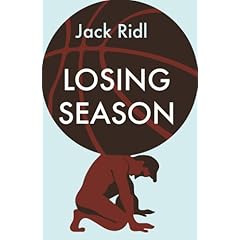
Losing Season Scores a Win


I just finished reading the poetry collection Losing Season by Jack Ridl--named by the Institute of International Sport as one of the most influential sports educators in American. Jack was my poetry professor at Hope College, and I was so excited that his book was being published (CavanKerry Press) because I loved his last collection, Broken Symmetry. Losing Season follows a high school basketball team through their terrible winning drought, and is told through the voice of the Coach, the bench-warmer, Coach's wife, the assistant coach and the equipment man.

One of my favorite parts comes in the poem "Scub," which is about the bench-warmer:

Sometimes, after practice,
I walk home slowly, and I
think about letting the ball
bounce away. Then I'd
sit down, let my mind
open up wider and wider,
so wide the sky would
come inside, the stars
would light it all.

Ridl's focus on the small things--walking home after practice, the memories people keep, feeding the birds or coming home to one's wife--is what keeps this collection moving. While at times, the topic is bleak (the team is losing! losing! losing!), Ridl's clear, concise poetry keeps the book from getting muddled with despair. It's a great read, even if you're not a big sports fan (like me!), because this book is about more than sports: hope, living up to expectations, perseverance, letting people down, and holding on to the moments that mean the most.

Follow Jack Ridl on twitter.
Listen to Jack read from Losing Season on NPR's Only a Game (around 25:00).

L. Stacks

Wednesday, October 21, 2009

Book Review: Her Fearful Symmetry

When I heard that Audrey Niffenegger, author of my favorite.book.of.all.time was releasing a new book this month, I was so happy that I nearly let out a neat little squeal. So when the beautiful teal-shimmered book arrived in my mailbox, I put aside a weekend to devour Her Fearful Symmetry.


The novel drew me in from the start. The first chapter is entitled "The End" and proceeded to unweave the death of Elspeth, which we find is the inciting incident for the whole novel. Opening a book with a death--an ending--is always intriguing for me.

The complex relationship between twins Julia and Valentina kept me reading this story, that and the fact that Niffenegger stayed true to her speculative ways in twisting this story about independence and growth into a ghost story. (Although I'm afraid I didn't find it very spooky!) Again, she wove a story filled with beautiful language, and unique, exact details. I loved the setting (in London! near a graveyard!) and the gothic feel the whole book evoked.

While I don't mind stories about time traveler's or ghosts, I'm afraid that I do like to read about realistic characters--and this is where Niffenegger fell short in her second book. One of the reasons I love The Time Traveler's Wife so dearly is because I feel as if I know the characters. However, in this novel I often found myself thinking the characters were falling quite flat, and I also questioned the likelihood of certain plot points.

I can't imagine how difficult it would be to write a novel after your first rose to critical acclaim, and even scored a movie deal. I would imagine the pressure would be practically unbearable. In all sincerity, if I hadn't read TTW before picking up Her Fearful Symmetry then maybe I would have been more satisfied--but, I too, was adding to Niffenegger's surely-felt pressure in hoping that her second novel would be as good as her first. The disappointment I felt at the end of the novel wasn't simply because of its lack of a happy ending.

L. Stacks

Monday, August 24, 2009

Summer Reading

Christine Schutt's All Souls is the best book I've read all summer. Granted, my summer reading has been basically zilch, unless you want to count this or this. But still, even if I had read dozens of books, I'm confident that All Souls would have been at the top of my list.


All Souls is the story of a handful of girls at a NYC prep school, with a focus on Astra Dell and her devastating illness. The story is told in small moments, with perspectives changing from teachers, Astra, parents, and other girls at Siddons School. While Schutt's novel is the story of high school girls and their always-dramatic lives, the scenes are beautifully woven, poignant, and aren't at all reminiscent of the drama in reality TV shows.

Schutt's writing style begs the reader to lean in closer--her sentences ebb and flow like water in a tub, there is something surprising on every page, and she is sweetly sad in her writing about tragedy. She surely will be named along with Abigail Thomas and Lorrie Moore as being an influence on my writing. I am so happy to find another writer who isn't afraid to take chances in writing in short sections and ever-changing POVs.

Here's a beautifully written passage (p.41), and be sure to check out more of her book if you get the chance:

Unattached

Anna Mazur said the teachers' lounge smelled of the movies, and Tim Weeks agreed and asked did she want to take a walk? The day was blue; the trees were in a flap. Fall color, October.

"Davidenja!" Tim Weeks said to one of the cleaning women as he and Anna Mazur passed an open door along the hall on their way out. Then Tim Weeks was smiling and looking only at her again, saying, "That's the only expression I know. I think it means 'good night.'"

Tim Weeks smiled at her; nonetheless, Anna Mazur continued to talk about her brother. His cancer--also rare. "My mother put her hands on his face, and that was the beginning of the end," Anna Mazur said then, "Why am I talking like this on such a beautiful day?"

L. Stacks

Tuesday, February 17, 2009

Coraline: Book vs Movie

The book wins, of course.

Okay, I guess it's not as simple for most people other than myself, so I will attempt to explain why. 

One reason I found the book so compelling was because it was a tale of a young girl, Coraline, taking on the world (or should I say the "Other" world) almost singlehandedly albeit a cat. In order to save her parents from the grasp of her Other Mother, Coraline has to win a finding-things game and outwit her Other Mother, who, we are told, is sometimes a cheat. Coraline is presented as witty, funny, and ruthless... she throws a cat at her Other Mother, for heaven's sake!

However, in the movie, the director must have thought that a plot involving a strong-willed, independent girl wouldn't sell. Meet: Wybie Lovat, the pester-some neighbor boy who might add a small amount of comic relief, but nonetheless saves Coraline when suddenly this movie-version can't seem to save herself.  Director Selick, do you not think it possible for a young girl to get by on her own, without help of a young man? 

Despite the addition of Wylie to the film, I found it otherwise a decent film. The pacing did seem off, and if the screenplay had stuck more closely to the book, I think it would have felt more even. I found the addition of some details pertaining to minor characters amusing, and aesthetically, I enjoyed the movie in 3-D. 

But overall, I'd have to say that the book was just a more pleasing experience for me. Imagining Gaiman's world was better than seeing it on screen, even in an "eye-popping 3-D." I found myself more attached to the characters in the book than in the movie, and appreciated Coraline's imagination and her mind in the book--for example, the brilliant tea party she has in the end of the book that wasn't included in the movie. 

So, read the book. And if you can't spare an hour out of your day (really, it's short and shouldn't take much longer than that) then I suppose you can just cut straight to the movie--just remember, out there on bookshelves and in the hands of young adults, Coraline herself is saving the day, and not just relying on some boy to do it for her.


Wednesday, January 21, 2009

The Story of Edgar Sawtelle

Recently finished a book I received for Christmas--the only one I didn't specifically ask for. The Story of Edgar Sawtelle by David Wroblewski was a book that, I admit, I was a bit skeptical about before reading. For one, it's an Oprah's Bookclub book. (I don't have anything against Oprah, nor do I really have anything for Oprah, but I often find that her books tend to feel almost as if they follow a pattern, or a formula.) 

However, I was pleasantly surprised by Edgar Sawtelle's story. Edgar, born mute (but not deaf) acquires a special relationship with the Sawtelle dogs that his family breeds and trains in a very new way. As a writer, I admired Wroblewski's gumption at writing several short sections entirely from one of the dog's point of view. Not only did Wroblewski do many daring things in the writing, the plot, and POV, I also felt that his descriptions were beautifully written, with a focus on the day-to-day moments of Edgar's life. Also, I was excited to see Wroblewski use the supernatural in a way that seemed to fit very well. 

It seems that some bloggers were unhappy with the ending of The Story of Edgar Sawtelle, I think that if Wroblewski had done anything different, he would not have been following the actual story, instead just giving readers what they wanted. I'm sure many of Oprah's Bookclub followers expect inspiring endings--and boy, am I grateful that Wroblewski stuck with his instincts and let his characters act out the true ending of this story. 

Not only was this novel a good read, it also gives a little bit of hope to all of us MFAers... Wroblewski recently graduated from Warren Wilson's MFA program, and this is his first novel--which leads me to think that this could very well be his thesis. SO it is possible for MFA grads to get published and make the NY Times bestsellers list. Whew. 

---

Well, I received an encouraging rejection letter this week! The magazine said that while they did not feel they could publish that particular story, they wanted me to submit more material soon. 

Oh, and this is also a 'hello' from sunny California, which is why I have fallen behind a bit on my postings. 

L. Stacks

Thursday, January 8, 2009

The Time Traveler's Wife: Thoughts

I just finished rereading one of my favorite books of all time: The Time Traveler's Wife by Audrey Niffenegger. The book takes places in Chicago, so it was really cool to reread it here, and to totally know some of the places that Henry and Clare go to (for example, the cafe where I used to wait tables). Niffenegger is a professor in the MFA program at Columbia College Chicago, and it's inspiring to know that TTW is her first novel.

As I was reading, I found myself wondering if Niffenegger herself uses a writing method similar to The Method that I explained earlier. Almost every section starts with the sentence "I am..." Then, throughout even the first paragraph, one can find what the "worst thing" is and the "we are here because" part. 

It's really amazing because while the book has a very intricate plot (a man time-travels almost as a sort of epilepsy, and always ends up stark naked in some place he normally has been before, and often encounters himself or his loved ones at other ages as he does so) the whole book is entirely scenes. I would be hard-pressed to find a section of explanation every thirty pages, even. Each scene is intricately crafted, emotionally felt, and while technically this is just another love story, it seems totally fresh and new. 

I once saw an "about me" section on someone's blog, and one question they answered was: What book do you wish you had written? For me, this is it. I am utterly jealous of Niffenegger's craft, her voice, her honesty, and of course the unbelievable creativity it took to come up with something as intricate as this. While I love reading this book, it also makes me just the tiniest bit sad because I wonder if I can ever end up with something as marvelously crafted as The Time Traveler's Wife is. 

L. Stacks